

What Do the Parts of a Sewing Machine Do?
The parts of a sewing machine each serve a specific function. The bobbin holds the lower thread that forms the underside of each stitch. The feed dogs grip and pull the fabric through the machine. The presser foot holds the fabric flat and steady. The needle carries the upper thread through the fabric to meet the bobbin thread and form a locked stitch. Additional parts — like the stitch selector, stitch length dial, and handwheel — give you control over stitch type, size, and needle position. Together, these parts work as a system to produce consistent, even stitches.
At first glance, your sewing machine may look complicated; however, all those buttons, leavers, and knobs you see are simple to use, and you'll be sewing in no time! We'll be showing you the parts of a sewing machine on the Janome 2030QDC, but keep in mind that every sewing machine will vary on the location and appearance of these parts. However, these parts should provide the same function for any brand of sewing machine!

Bobbin and Bobbin Case
A bobbin is a removable part that is wound with thread and makes the underside of a machine stitch. The bobbin case holds the bobbin.


Feed Dogs
The feed dogs are what ride underneath the presser foot. They almost look like metal teeth! As fabric goes through, the feed dogs come up and help pull the fabric along.

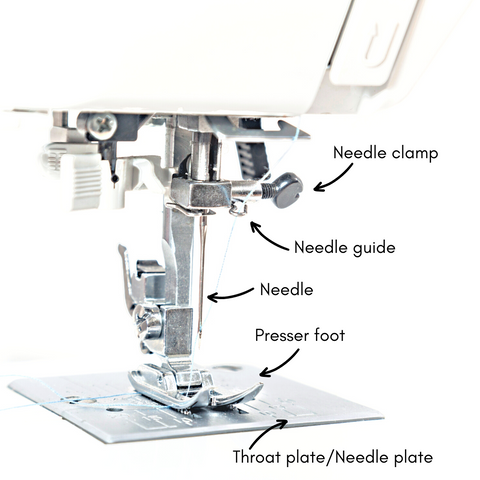
The presser foot presses and holds the fabric down on the feed dogs to give stability while you sew, which is controlled by a lever on your machine.

Needle and Needle Clamp
Needles are removable and made for the thread to go through. A needle clamp holds the needle in place.
Throat/Needle Plate
This metal plate sits with a small opening below the needle and presser foot. It allows the bobbin thread to come out and the needle to pass through to make stitches. This plate can be removed for cleaning.
Spool Pin
A small dowel holds the thread. Your machine may have spool pins that can be horizontal or vertical.

From the spool pin, the thread passes through these metal loops to help regulate the tension of the thread.

Flywheel/Handwheel
This knob raises and lowers the take-up lever and the needle. The recommendation is to always turn the wheel towards you.

Stitch Selector
Newer machines have buttons to select stitches, while older sewing machines will have a dial to choose different machine stitches. There is usually an image or printed diagram on the machine (or within its software) of how the stitch looks.

Stitch-Length Selector
This dial or lever controls the length of the stitches. You can make them longer or shorter, however your machine may have a limit of how much you can manipulate the stitch. Many machines will have an image of dotted lines that gradually get longer at the end. This indicates that that button is the stitch-length selector. There are also machines out there that have stitch-length dials that are numbered that you can turn to lengthen your stitch.

Stitch Width-Selector
This dial or lever controls the width of decorative stitches. Many machines will have an image of a zig zag stitch that gradually gets wider at the end, this indicates that that button is the stitch-width selector.

Menu Screen
On electronic machines, this menu screen allows you to adjust functions and stitches.
Reverse-Stitch/Backstitch Button
This button will reverse the direction of the feed dogs pulling as long as you are holding that button. Most often you'll want to use the backstitch button at the beginning and end of your stitch line to reinforce those stitches.

Foot Pedal/Foot Controller
It controls and regulates the speed of the machine by pressing it with your foot.

And there you have it... the basic buttons and functions of a sewing machine! No worries if you don't remember everything right away; you can refer back to this guide over and over again!
Follow our YouTube channel for even more sewing education!
Ready to Find Your Perfect Machine?
If you're just getting started and looking for the right sewing machine, we'd love to help. Our team at My Girlfriend's Quilt Shoppe carries a range of machines for every skill level, and we're here to walk you through your options.
Have questions? Reach out to our team anytime.
📧 info@mygirlfriendsquiltshoppe.com
📞 435-213-3229
Frequently Asked Questions
What is the most important part of a sewing machine?
Every part plays a role, but the needle, bobbin, and feed dogs work together to form every stitch. Without any one of them working correctly, your stitching will suffer.
What does the bobbin do on a sewing machine?
The bobbin holds the lower thread that forms the underside of your stitch. It works together with the top thread through the needle to create a locked stitch in your fabric.
What do feed dogs do on a sewing machine?
Feed dogs are the small metal teeth beneath the presser foot that grip the fabric and pull it through the machine at a consistent rate as you sew.
What is the presser foot for?
The presser foot holds your fabric flat against the feed dogs while you sew, keeping it stable and preventing it from shifting.
What does the handwheel do on a sewing machine?
The handwheel manually raises and lowers the needle and take-up lever. It gives you precise control, especially when starting or ending a seam. Always turn it toward you.
What is the throat plate on a sewing machine?
The throat plate, also called the needle plate, is the metal plate beneath the needle and presser foot. It has markings to guide seam allowances and a small hole for the needle and bobbin thread to pass through.
What does the stitch length selector do?
The stitch length selector controls how long each stitch is. A shorter stitch is stronger and better for seams, while a longer stitch works well for basting or gathering.
P.S. If you're shopping for your first sewing machine — or ready to upgrade — our team is here to help you find the right fit. Browse our machines and services or reach out anytime at info@mygirlfriendsquiltshoppe.com.